
US Government splurges $12.7B to save 10 wealthy depositors

TL;DR Breakdown

  • The US government has spent $12,700,000,000 to bail out 10 wealthy depositors amid the banking crisis in March 2023.
  • Several high-profile regional banks went bankrupt in the spring of 2023, including Silicon Valley Bank (SVB), Signature Bank, and First Republic Bank. 
  • What happens to other clients? Is the US government headed for worse times than the Great Depression?

Description

The US Government has portrayed a level of injustice to so many in the economic society following the crash of several big banks. According to sources, the Federal Deposit Insurance Corporation (FDIC) has released an unredacted document revealing that the US government guaranteed the accounts of Silicon Valley Bank’s (SVB) top ten clients following its … Read more

The US Government has portrayed a level of injustice to so many in the economic society following the crash of several big banks. According to sources, the Federal Deposit Insurance Corporation (FDIC) has released an unredacted document revealing that the US government guaranteed the accounts of Silicon Valley Bank’s (SVB) top ten clients following its highly publicized failure in March. This should not come as a surprise – investors should have seen this coming and known better: The rich get richer, and the poor just sink further deep.

US Government definitely favors the rich

American Catholic priest, sociologist, theologian, and author of racy bestselling novels such as The Cardinal Sins, Father Andrew Greeley, once said, “It should be no surprise that when rich men take control of the government, they pass laws that are favorable to themselves. The surprise is that those who are not rich vote for such people, even though they should know from bitter experience that the rich will continue to rip off the rest of us.” 

Americans are living the proof of that right through this day. The year 2023 may go down in history as the year America lost faith in its banks. The US government and its banking system has left more questions than answers. This has led to mistrust and many giving up on the industry entirely.

Several high-profile regional banks went bankrupt in the spring of 2023, including Silicon Valley Bank (SVB), Signature Bank, and First Republic Bank. These banks were not limited to a single geographic location, and their failures were not due to a single cause.

The news roiled the financial markets, shook the banking industry, and unnerved the general population. Fears grew that financial contagion was in the works, which occurs when a crisis in one sector spreads to other parts of an economy, country, or region—with fatal results. So what did the US government do? They bailed out the wealthy. Here sits the transactions in detail.

FDIC detailed bailout report

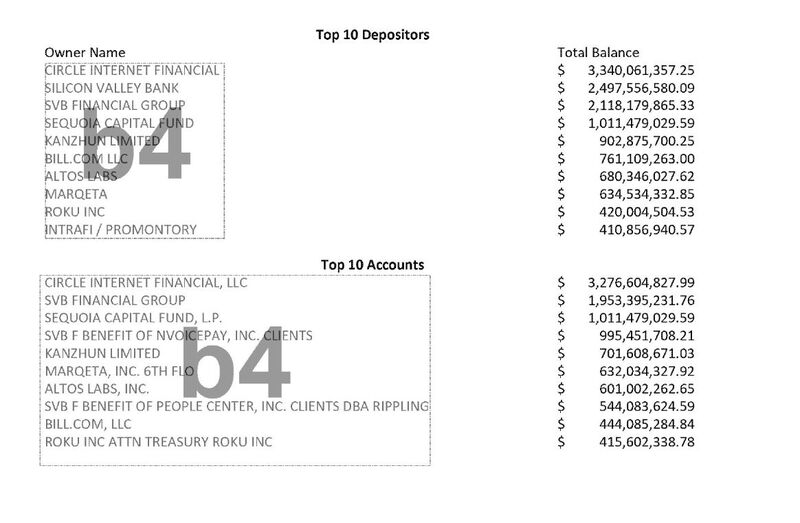
Following a Freedom of Information Act request from Bloomberg, the FDIC “mistakenly” disclosed the full version of the document. The document discloses the names of the firms that were bailed out, as well as the total deposits that greatly exceed the $250,000 FDIC limit per account.

Stablecoin issuer Circle was the largest depositor at SVB, contributing $3,3 billion. In March, the Boston-based company reported that $3.3 billion of the $40 billion supporting its stablecoin USD Coin (USDC) was initially trapped in a bankrupt institution.
US Government splurges .7B to save 10 wealthy depositorsUS Government splurges .7B to save 10 wealthy depositors

Who got what?

1. Sequoia – The $1 billion that Sequoia, a renowned firm that has backed companies such as Apple, Google, and WhatsApp, had at SVB represented a small portion of its $85 billion in assets under management. Michael Moritz, a partner at the firm, wrote in the Financial Times that, in addition to maintaining its own accounts with the lender, the firm advised every startup it funded to do the same. 

2. Kanzhun – According to the document, Kanzhun had $902.9 million in deposits with SVB. Before going public on the Nasdaq in 2021, the company was significantly backed by Chinese behemoth Tencent, making it one of the largest Chinese companies to go public in the United States that year.

3. Altos Labs Inc. – a cell regeneration-focused life sciences firm, deposited $680,3 million with the bank. The privately held company has raised $3.27 billion from investors including billionaires Jeff Bezos and Yuri Milner, as well as Mubadala Investment Company and other investors. 

4. Marqeta Inc. – The document shows that the payments startup had $634.5 million in the bank. The company acknowledged in a statement that it had “significant deposits” at SVB but was in the process of transferring funds to other banks.

5. IntraFi Network, which provides deposit services to financial institutions, had $410.9 million worth of deposits at the bank, according to the document. 

6. Circle Internet Financial Ltd. disclosed its SVB deposits, which at the time represented 8.2% of the reserves supporting its USD Coin previously. According to the document, SVB’s largest depositor had a balance of $3.3 billion.

7. Roku Inc., a manufacturer of streaming set-top boxes, previously disclosed that approximately 26% of its cash and cash equivalents were held at the bank. The document indicated a $420 million balance.

8. Bill.com previously disclosed it had approximately $670 million in the bank. The company stated that the sum included approximately $300 million of its own funds and $370 million belonging to customers. According to the FDIC document, Bill.com’s total balance was $761,1 million.

Is it over? Or is the US government banking sector set for a Great Depression repeat?

The banking problems of the US government are far from over. According to Morgan Stanley analysts, American banks could lose nearly $500 billion as a result of the US Treasury’s upcoming plan to issue a new series of Treasury bills.

According to CNBC, Morgan Stanley forecasts a total of $1.364 trillion in net T-bill issuance for the remainder of this year, of which $1 trillion will be issued within the next four months. The bank warns that this new surge of U.S. bonds may place significant strain on banks that cannot match the us government’s yields.

Disclaimer. The information provided is not trading advice. Cryptopolitan.com holds no liability for any investments made based on the information provided on this page. We strongly recommend independent research and/or consultation with a qualified professional before making any investment decision.

文章来源于互联网:US Government splurges $12.7B to save 10 wealthy depositors

Disclaimers:

1. You are solely responsible for your investment decisions and this info is not liable for any losses you may incur.

2. The copyright of this article belongs to the writer, it represents the writer's opinions only, not represents the site's ones. Not financial advice.

Previous 2023年6月29日 12:08
Next 2023年6月29日 13:14

Related articles

  • Flow Coin Price Prediction 2023-2032: Is FLOW a Good Investment?

    Flow Price Prediction 2023 – up to $1.08 Flow Price Prediction 2026 – up to $3.42 Flow Price Prediction 2029 – up to $10.05 Flow Price Prediction 2032 – up to $30.58 Seasoned traders go by the time-tested formula: invest most of your crypto portfolio in BTC (50%); 35% in a basket of big-cap coins, and the rest in small projects with huge upside. But for beginners, all cryptocurrencies are risky investments, so they must tread lightly and keep all their senses open in the crypto space. Let’s see what we can take away from this Flow Coin Price Prediction. The Flow ecosystem continues to build innovative products and solutions despite what’s happening with other similar organizations. Look at some of the Flow community’s achievements in Q1 to know the potential as the layer 1 blockchain of choice for building and scaling mainstream powerful innovations. Much of the broad-based interest in FLOW appears to be due to a big listing announcement. Specifically, crypto exchange Coinbase announced that Flow would be the latest crypto investors can trade on the platform. How high can the “Coinbase effect” take Flow?…

    Article 2023年6月19日
  • LUNC validator breathes new life into struggling community

    TL;DR Breakdown ClassyCrypto’s return brings renewed hope for the struggling LUNC Classic cryptocurrency. ClassyCrypto plans to actively participate in the LUNC network’s governance and collaborate with developers for substantial changes. The LUNC community eagerly anticipates ClassyCrypto’s reinvigorated involvement in the project. Description In a surprising turn of events, popular Twitter personality, and LUNC validator, ClassyCrypto, has breathed new life into the struggling LUNC Classic (LUNC) cryptocurrency. Taking to Twitter, ClassyCrypto announced his intentions to participate in the LUNC network’s governance actively, signaling a strong commitment to pushing for substantial changes. Acknowledging the past failures and setbacks of … Read more In a surprising turn of events, popular Twitter personality, and LUNC validator, ClassyCrypto, has breathed new life into the struggling LUNC Classic (LUNC) cryptocurrency. Taking to Twitter, ClassyCrypto announced his intentions to participate in the LUNC network’s governance actively, signaling a strong commitment to pushing for substantial changes. Acknowledging the past failures and setbacks of the LUNC system, ClassyCrypto emphasized that these experiences have served as valuable lessons for both LUNC validators and other interested parties. In a recent tweet,…

    Article 2023年7月9日
  • U.S. Trustee challenges Delaware Bankruptcy Court’s ruling in FTX case, seeks reversal

    TL;DR Breakdown The U.S. Trustee has directed the Delaware bankruptcy court to reverse its ruling on the independent examiner’s decision in the FTX bankruptcy case. The court rejected the appointment request despite meeting the criteria for appointing an examiner, citing potential high costs and delays. The DOJ Trustee argues that the alleged costs are insufficient justification for deviating from the statutory requirement of appointing an examiner. In a court filing on Wednesday, the U.S. Trustee, a Department of Justice (DOJ) branch, directed the Delaware bankruptcy court to reverse its previous ruling on the independent examiner’s decision in the FTX bankruptcy case. According to reports, the Trustee has stated that the bankruptcy court erred in its ruling during a court hearing held in February. The court had rejected the appointment request in a case where the criteria for appointing an examiner were met, including the requirement that the bankrupt estate has over $5 million in “qualifying liabilities.” In the February hearing, Judge John Dorsey from the Delaware bankruptcy court took the initiative by siding with the FTX estate. During the proceedings,…

    Article 2023年5月19日
  • Jack Dorsey’s historic tweet-turned-NFT: What’s the latest?

    TL;DR Breakdown Jack Dorsey’s first-ever Tweet, turned NFT, which was bought for $2.9 million, now has a bid of just $1.14. Sina Estavi, CEO of Malaysia-based crypto firm Bridge Oracle, is the current owner of the NFT. The NFT and wider tech markets have faced significant downturns, with bankruptcies and layoffs across the sector. Description Just over two years ago, Jack Dorsey, the co-founder and ex-CEO of Twitter, carved a unique niche in the digital world by turning the first-ever Tweet into a non-fungible token (NFT). This significant pivot in the interplay of technology, social media, and digital art made waves in the digital assets market. However, the recent trajectory … Read more Just over two years ago, Jack Dorsey, the co-founder and ex-CEO of Twitter, carved a unique niche in the digital world by turning the first-ever Tweet into a non-fungible token (NFT). This significant pivot in the interplay of technology, social media, and digital art made waves in the digital assets market. However, the recent trajectory of Dorsey’s historic NFT leaves market watchers in a state of surprise….

    Article 2023年7月20日
  • Stepn launches in-app NFT marketplace with Apple Pay integration

    TL;DR Breakdown Stepn launches in-app NFT marketplace within its iOS app, allowing users to buy and sell digital assets directly. The integration of Apple Pay streamlines transactions, enabling users to purchase NFTs using credit and debit cards. Stepn circumvents Apple’s 30% fee by introducing an in-app currency called Sparks, abstracting the crypto elements and incorporating the fees into the process. Stepn, the innovative mobile “move-to-earn” game that rewards users with crypto tokens for physical activity, has taken a groundbreaking leap in the blockchain world. The app has unveiled its in-app marketplace for NFT sales, accessible within its iOS app for Apple’s iPhone. Moreover, Stepn has integrated Apple Pay, enabling users to make purchases using credit and debit cards. Enabling NFT purchases and streamlining transactions Typically, mobile apps do not support NFT purchases on the secondary market due to the complexities associated with the 30% fee imposed by Apple and Google on most in-app transactions, including NFTs. App developers face the choice of either passing on the extra fee to users or absorbing it as a cost of doing business. In…

    Article 2023年5月24日
TOP