
Breaking: Indian Tax portal – AIS, now shows Digital Currency Transactions

TL;DR Breakdown

  • India has one of the most robust crypto taxation systems, with the introduction of crypto taxes on their Annual Information Statement (AIS) forms.
  • The Virtual Digital Asset tax class went into effect on July 1, 2022, after the provisions in India’s Budget 2022.
  • The AIS is the extension of Form 26AS.

Description

Is crypto taxed in India? Yes, virtual digital assets, or crypto assets, are taxed in India after the Union Budget 2022. For the first time, the government officially termed digital assets, including crypto assets, under “Virtual Digital Assets.”  And now, the Indian Tax Portal, known as the Account Information System (AIS), has undergone a significant … Read more

Is crypto taxed in India? Yes, virtual digital assets, or crypto assets, are taxed in India after the Union Budget 2022. For the first time, the government officially termed digital assets, including crypto assets, under “Virtual Digital Assets.”  And now, the Indian Tax Portal, known as the Account Information System (AIS), has undergone a significant upgrade that brings forth a new capability to track and monitor digital currency transactions. 

Everything you need to know about crypto tax in India

Along with cryptocurrencies such as Bitcoin and Ethereum, NFTs have been included in India’s definition of ‘Virtual Digital Asset.’ What are Virtual Digital Assets: A Virtual Digital Asset is any code or token that is generated through cryptographic means and functions as a store of value.

Each VDA should be viewed as a separate asset class. Therefore, a loss on the sale of one VDA cannot be used to offset gains on the sale of another VDA. According to the 115BBH section of the Finance Bill, a crypto-taxable event is defined as:

1. Conversion of any digital assets to INR or any other fiat currency.

2. Conversion of one virtual digital asset type to another may include crypto-to-crypto trading or trading in stablecoins.

3. Paying for goods and services using a virtual digital asset.

It is specially intended to tax cryptocurrencies and, at first glance, excludes digital gold, central bank digital currency (CBDC), and any other traditional digital assets.

Gains from the transfer of VDA are subject to a 30% tax rate, which must be increased by the Health and Education Cess and surcharge, if applicable. In addition, because the tax rate is a special rate of tax, the fundamental exemption limit shall not apply to it. Here is a summary:

1. At the end of each fiscal year, income from the transfer of virtual digital assets such as crypto and NFTs will be taxed at 30%.

2. When reporting revenue from the transfer of digital assets, no deduction will be allowed save for the cost of acquisition.

3. Losses from digital assets cannot be offset against other sources of income.

4. Gifting digital assets will result in taxation in the hands of the receiver. 

5. Losses from one virtual digital currency cannot be offset against gains from another virtual digital currency. Because it was announced in Budget 2022, the 1% TDS point should also be included in this list of pointers.

In accordance with the revised Income Tax Regulations, the 1% TDS applies to all sales of crypto assets. This was implemented on July 1, 2022. Please note, however, that the TDS will be deducted from the total amount of the transaction, not just the profits. It makes no difference to TDS whether you earn a profit or incur a loss on your trade. It will be deducted regardless.

Now here is the thing: Crypto taxation in India has made it to the AIS. What does that mean for crypto investors in the country – Read on.

India’s AIS – What is it, and why is it important to India’s crypto investors?

In addition to increasing self-assessment opportunities, India has streamlined tax compliance through digitization and simpler information access. The new Annual Information Statement (AIS) is one of these measures, though it will be used in conjunction with Form 26A until the tax department indicates otherwise. 

The consolidated statement, which is available on the tax compliance portal and can be accessed with the taxpayer’s PAN number, will include additional categories of information.

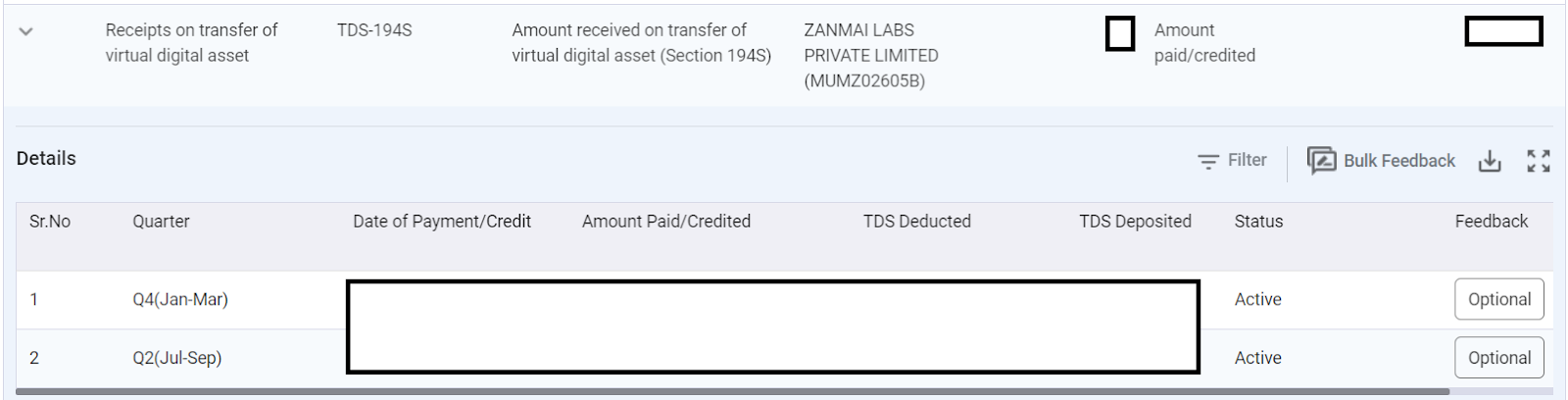
AIS is the extension of Form 26AS. Form 26AS provides information regarding property acquisitions, high-value investments, and TDS/TCS transactions that occurred during the fiscal year. AIS also includes interest on savings accounts, dividends, rent received, purchase and sale transactions of securities and immovable properties, foreign remittances, interest on deposits, GST turnover, etc. Now the taxation system has also added crypto tax to that list.

This is the first time Indian Income Tax seems to show digital transactions and trading-related transactions in AIS. This means there is no way crypto traders can escape from paying taxes as per their income tax slab.
Breaking: Indian Tax portal – AIS, now shows Digital Currency TransactionsBreaking: Indian Tax portal – AIS, now shows Digital Currency Transactions

Through this measure, the Indian government has ensured that there is no loophole for crypto investors to pass up paying their taxes according to the recent regimes. The move by the nation is one many countries leaning on taxing crypto are looking up to learning from. This financial year will see crypto taxes filed in their entirety.

Breaking: Indian Tax portal – AIS, now shows Digital Currency TransactionsBreaking: Indian Tax portal – AIS, now shows Digital Currency Transactions
Disclaimer. The information provided is not trading advice. Cryptopolitan.com holds no liability for any investments made based on the information provided on this page. We strongly recommend independent research and/or consultation with a qualified professional before making any investment decision.

文章来源于互联网:Breaking: Indian Tax portal – AIS, now shows Digital Currency Transactions

Disclaimers:

1. You are solely responsible for your investment decisions and this info is not liable for any losses you may incur.

2. The copyright of this article belongs to the writer, it represents the writer's opinions only, not represents the site's ones. Not financial advice.

Previous 2023年7月5日 10:16
Next 2023年7月5日 12:00

Related articles

  • Crypto scams, hacks, and rug pulls drop dramatically in H1 2023

    TL;DR Breakdown According to a recent report by Beosin, a Web3 security firm, the total value of cryptocurrencies lost in scams, hacks, and rug pulls during the first half of 2023 amounted to $656 million.  The report highlights that approximately $215 million of stolen assets were actually recovered, which accounts for 45.5% of all the stolen assets. The report indicates that the majority of crypto lost in the first half of 2023 were coins and tokens minted on the Ethereum blockchain, accounting for 75.6% of the total losses. Description According to a recent report by Beosin, a Web3 security firm, the total value of cryptocurrencies lost in scams, hacks, and rug pulls during the first half of 2023 amounted to $656 million. This figure includes $471.43 million lost in 108 protocol attacks, $108 million in various phishing scams, and $75.87 million from 110 rug … Read more According to a recent report by Beosin, a Web3 security firm, the total value of cryptocurrencies lost in scams, hacks, and rug pulls during the first half of 2023 amounted to $656 million….

    Article 2023年7月3日
  • Tether uses Bitcoin to strengthen its reserves

    TL;DR Breakdown Tether International Limited has announced a new investment strategy where it will use up to 15% of its net realized operating profits to purchase Bitcoin regularly. The Bitcoin purchase initiative aims to strengthen, diversify, and amplify Tether’s reserves, enhancing transparency about the company’s performance and capital allocation strategy. Unlike other institutional investors, Tether maintains possession of the private keys for all its Bitcoin holdings, demonstrating a strong commitment to security. In a bold move that marks a significant strategy shift, Tether International Limited, the organization behind the pioneer and most popular stablecoin, has declared its new investment plan. The strategy entails strengthening its reserves portfolio through periodic Bitcoin (BTC) purchases, using up to 15% of its net realized operating profits, according to the company’s recent announcement. Tether’s investment strategy The company’s recent endeavors to purchase Bitcoin are part of an initiative aimed at amplifying, diversifying, and fortifying its reserves. By doing so, Tether aims to enhance transparency, providing a more precise portrayal of its financial performance and capital allocation strategy. The company stated that it would concentrate solely…

    Article 2023年5月18日
  • OKCoin’s US subsidiary warned by FDIC for misleading insurance claims: what you need to know

    TL;DR Breakdown The FDIC has warned OKCoin’s American crypto exchange subsidiary for making misleading claims. OKCoin falsely stated on its website that the HASH token had received regulatory acceptance from the SEC, OCC, FED, and the FDIC. The FDIC clarified that their insurance coverage only applies to banks within the US and does not extend to crypto exchanges. The US Federal Deposit Insurance Corporation (FDIC) has issued a public warning regarding OKX’s American crypto exchange subsidiary, raising concerns about the company’s misleading claims. In a letter addressed to OKCoin’s CEO Hong Fang, the FDIC highlighted instances where the firm misrepresented itself as insured by a well-known US financial institution regulator. The FDIC singled out three specific fraudulent statements made by OKCoin. The exchange falsely stated on its website that the HASH token, issued by Provenance Blockchain and traded on their platform, had “received broad regulatory acceptance from the SEC, OCC, FED, and the FDIC.” Furthermore, in 2020, the FDIC became aware of OKCoin’s misleading assertions on their website, proclaiming to be “licensed across the US with FDIC insurance on OKCoin…

    Article 2023年6月19日
  • African banks in panic mode as fintech and telcos gain ground

    TL;DR Breakdown Around 40% of the 153 African banks surveyed by African Banker’s annual report view fintechs and telcos as substantial threats. 69% of the surveyed banks consider artificial intelligence (AI) as the key technology shaping the banking industry’s future. Despite the recognized importance of digital technology, only 28% of the banks are spending more than $3 million annually on digital transformation and innovation. The banking landscape in Africa is at a crossroads, with nearly half of the continent’s financial institutions identifying fintechs and telecommunications companies as significant threats, according to the most recent African Banker annual report. With the rapid digital transformation across industries, the banking sector in the continent is being compelled to adapt or risk being sidelined. Disruption in the African banking landscape The survey included 153 African banks, with approximately 40% signaling high concern over the rise of fintechs and telcos in the financial ecosystem. Meanwhile, a significant 69% saw artificial intelligence (AI) as the most critical technology shaping the banking industry’s future. However, despite recognizing the looming revolution, only a little over a quarter of…

    Article 2023年5月21日
  • Google to let blockchain and NFT apps on Android

    TL;DR Breakdown Google has announced new rules that allow blockchain and NFT apps on Android. Developers need to be clear about any in-app NFTs or tokenized digital assets. Google prohibits glamorizing potential earnings from NFTs or blockchain activities. The guidelines ensure adherence to Google’s existing Real-Money Gambling, Games, and Contests policy. Description Bridging the gap between technology and transparency, Google is set to integrate blockchain and non-fungible tokens (NFTs) into its Android platform. Having announced a policy shift earlier this year to facilitate clearer NFT guidelines, Google has now disclosed a comprehensive set of rules regulating these innovative digital experiences. Google’s embrace of blockchain technology Underlining the … Read more Bridging the gap between technology and transparency, Google is set to integrate blockchain and non-fungible tokens (NFTs) into its Android platform. Having announced a policy shift earlier this year to facilitate clearer NFT guidelines, Google has now disclosed a comprehensive set of rules regulating these innovative digital experiences. Google’s embrace of blockchain technology Underlining the perpetual growth and expansion of digital economies, Google’s policy update marks a significant shift in…

    Article 2023年7月13日
TOP