
A look at Bitcoin vs. the $156 trillion global payment industry

TL;DR Breakdown

  • The cross-border payments sector is expanding rapidly and steadily, yet incumbents in all segments lack incentives. Bitcoin might be of help.
  • According to EY, 96.7% of cross-border payments are B2B, with a total value of $150.7 trillion in 2022. 
  • Bitcoin B2B cross-border payments remain unused at present as 89% of consumers do not use Bitcoin for transactions and instead hold it for profit.

Description

With the advent of new technologies built on top of the Bitcoin Network, Bitcoin’s use case for payments has expanded. However, why has business and consumer implementation of payments been so slow to date? What has been constructed, and what is lacking? The cross-border payments industry is expanding rapidly and consistently, but incumbents in all … Read more

With the advent of new technologies built on top of the Bitcoin Network, Bitcoin’s use case for payments has expanded. However, why has business and consumer implementation of payments been so slow to date? What has been constructed, and what is lacking?

The cross-border payments industry is expanding rapidly and consistently, but incumbents in all segments lack incentives to substantially enhance the payments infrastructure. Their focus is on profit competition, which makes data sharing unattractive and revenue decline a low priority.

No consumer-facing or business-facing financial institution owns the underlying infrastructure, making it too easy for customers to avoid responsibility.

The cross-border payment industry

In 2023, it is possible to convey information to 86% of the world’s population almost instantly: through smartphones. However, transmitting money to anyone still takes days and costs an average of 6.24%. According to EY, in 2022, a projected $155.9 trillion will be transported abroad, up from $127.8 trillion in 2018. Other research institutions present contradictory information about this enigmatic sector.

A look at Bitcoin vs. the 6 trillion global payment industryA look at Bitcoin vs. the 6 trillion global payment industry

The cross-border payments sector is expanding rapidly and steadily, yet incumbents in all segments lack incentives to significantly upgrade the underlying payments infrastructure.

According to the report, 78.8% of remittances, or $626 billion in 2022, went to low- and middle-income regions. Money transfers take days and cost 6.24% on average for remittances. This might theoretically drop to 3.31% if all consumers were completely aware of their options.”

According to The Global Findex Database 2021, worldwide adult ownership of financial accounts has increased from 51% in 2011 to 76% in 2021, and an estimated 10% of the global population does not have a government-issued ID to open an account.

A look at Bitcoin vs. the 6 trillion global payment industryA look at Bitcoin vs. the 6 trillion global payment industry

Cross-border payment innovation is currently focused on two major initiatives: 

1) the international integration of national instant payment systems and 

2) the development of Central Bank Digital Currencies (CBDCs).

CBDCs receive little consideration inside the business for the enormous threat they pose in the hands of oppressive regimes seeking to target, punish, tax, and financially control specific segments of the population. According to Our World in Data, such totalitarian regimes house 70% of the world’s population. There is no regulation in place, nor are there any features that would preclude CBDCs from being used to impose government policies.

A look at Bitcoin vs. the 6 trillion global payment industryA look at Bitcoin vs. the 6 trillion global payment industry

The global Bitcoin adoption

There are around 800,000 active Bitcoin addresses per day, although this is not an exact reflection of the number of daily users due to the technical nature of Bitcoin. According to Glassnode, there are approximately 32.9 million active entities in Bitcoin and approximately 44.4 million addresses with usable balances.

Moreover, as of June 2023, there are approximately 2.34 million bitcoin stored on 20 major exchanges. 500k BTC is on Coinbase, and 630k BTC is on Binance. These exchanges are currently under the SEC investigation. On all exchanges worldwide, analysts estimate a range of 48.8 – 97.5 million Bitcoin holders.

There is a significant overlap between the 32.9 million active entities and exchange users, as an estimated 70% of users store Bitcoin on exchanges and 80% in mobile or desktop wallets.

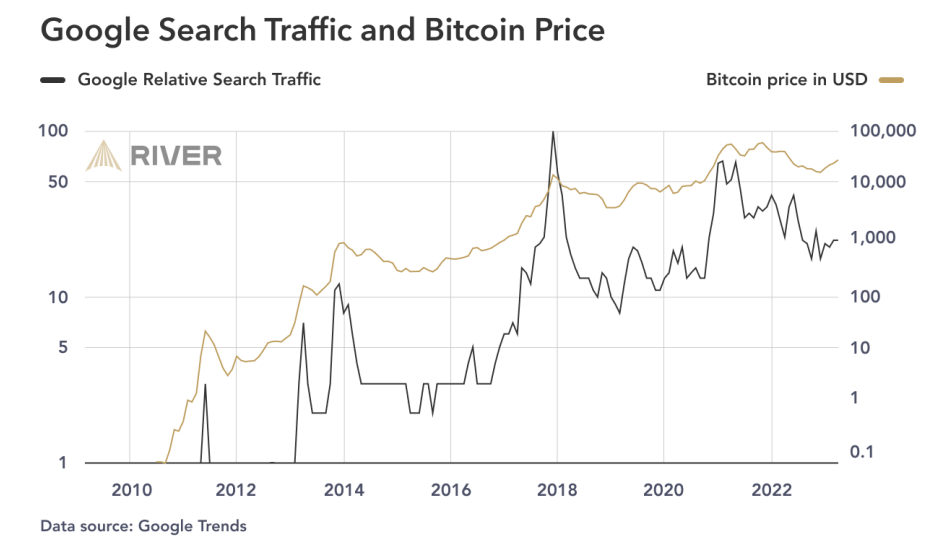
From 2013 to 2023, the relative Google search volume for Bitcoin was highest in Nigeria and El Salvador, where the average search query was nearly twice as likely to be about Bitcoin than in Austria, The Netherlands, and Switzerland.
A look at Bitcoin vs. the 6 trillion global payment industryA look at Bitcoin vs. the 6 trillion global payment industry

Finally, globally, the number of individuals sending remittances (200 million) could be 100 to 400% greater than the number of Bitcoin holders.

Bitcoin cross-border payments

Bitcoin B2B cross-border payments remain unused at present. Generally, B2B is the last to embrace new technologies. It is perceived as a challenge to not only integrate the technology but also educate many different parties.

89% of consumers do not use Bitcoin for transactions and instead hold it for profit. The taxation regulations that transform Bitcoin transactions into taxable events discourage U.S. consumers from using Bitcoin.

From January to May of 2022, El Salvador’s central bank reported that Chivo Wallet processed $52 million in remittances or 1.6% of its estimated total volume of $3,175,000,000,000. Given Bitcoin’s relative novelty, this number is relatively significant.

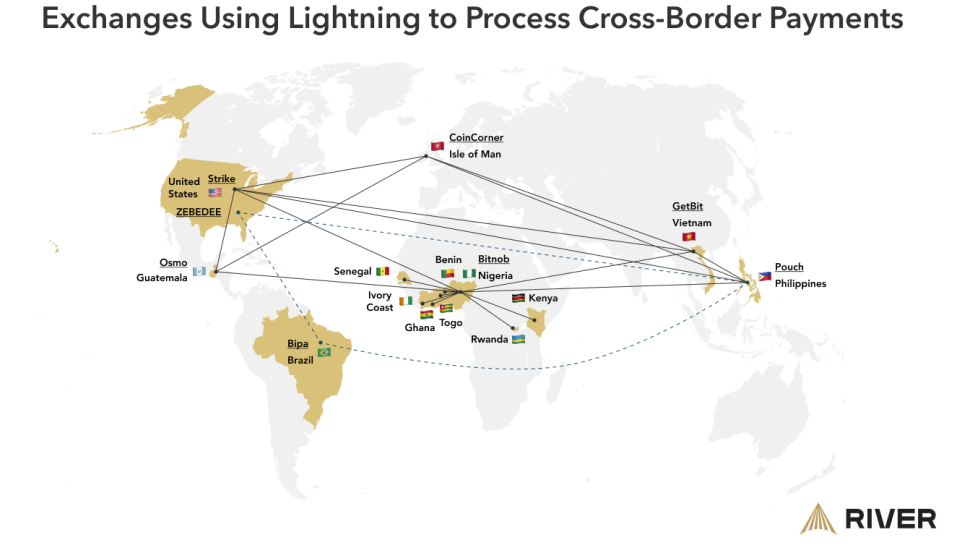
As described in the report, six companies on five continents have begun constructing payment networks using Lightning as the back-end infrastructure as of late 2022. In the future years, market analysts expect additional institutions to join them.
A look at Bitcoin vs. the 6 trillion global payment industryA look at Bitcoin vs. the 6 trillion global payment industry

BTC proponents have a great deal of work and self-reflection to do if they intend to educate those who are currently uninterested in BTC. These advocates must explain BTC in a manner that resonates with the particular listener rather than from a general or subjective standpoint.

In addition, they must acquire additional learning experiences via articles, books, and podcasts. Lastly, they must target individuals who are already aware that fiat currency is flawed:

1. 2.5 billion people in 54 countries live with double-digit inflation.

2. Countries that heavily rely on remittances.

 3. Countries with capital controls and black markets for currency.

A look at Bitcoin vs. the 6 trillion global payment industryA look at Bitcoin vs. the 6 trillion global payment industry

Over the years, many efforts have been undertaken to increase BTC’s use in international transactions. Adoption is presently low in absolute terms, as Bitcoin’s primary function is not as a medium of exchange. As the world learns more about Bitcoin’s function as a store of value, the majority of users still prefer to hold their Bitcoins.

Despite this, B2C, C2B, and C2C cross-border payments adoption has been steadily increasing, and there are a number of legitimate use cases in which people around the world rely on Bitcoin for payments.

Disclaimer. The information provided is not trading advice. Cryptopolitan.com holds no liability for any investments made based on the information provided on this page. We strongly recommend independent research and/or consultation with a qualified professional before making any investment decision.

文章来源于互联网:A look at Bitcoin vs. the $156 trillion global payment industry

Disclaimers:

1. You are solely responsible for your investment decisions and this info is not liable for any losses you may incur.

2. The copyright of this article belongs to the writer, it represents the writer's opinions only, not represents the site's ones. Not financial advice.

Previous 2023年7月8日 02:56
Next 2023年7月8日 03:34

Related articles

  • Terraform Labs Seeks Access to FTX Wallets in Fraud Case Defense

    TL;DR Breakdown Terraform Labs faces fraud allegations by the SEC for an unregistered securities offering involving TerraUSD and Luna tokens. The company seeks access to FTX wallets through subpoenas to find evidence of short sellers’ involvement and defend against the collapse of its stablecoins. Description Terraform Labs, the blockchain company at the center of an ongoing fraud case brought forth by the U.S. Securities and Exchange Commission (SEC), is making headlines once again for its unconventional defense strategy. Seeking to counter the SEC’s allegations of conducting an unregistered securities offering through the issuance of TerraUSD and Luna tokens, Terraform Labs … Read more Terraform Labs, the blockchain company at the center of an ongoing fraud case brought forth by the U.S. Securities and Exchange Commission (SEC), is making headlines once again for its unconventional defense strategy. Seeking to counter the SEC’s allegations of conducting an unregistered securities offering through the issuance of TerraUSD and Luna tokens, Terraform Labs has set its sights on accessing crucial information from the now-bankrupt FTX crypto exchange. Contents hide 1 Terraform Labs Requests Subpoena of…

    Article 2023年7月21日
  • Major U.S. banks lose $262 billion in deposits; Heartland Tri-State Bank collapses

    TL;DR Breakdown Major U.S. banks lost $262 billion in deposits in a year; regional banks gained customers. Heartland Tri-State Bank collapsed on July 28th; assets transferred to Dream First Bank, N.A. Despite deposit loss, major banks like JPMorgan still report substantial profits. Description The U.S. banking industry is experiencing a significant transformation as major banks lose customer deposits while smaller regional banks gain traction. The Federal Deposit Insurance Corporation (FDIC) recently announced the failure of Heartland Tri-State Bank of Elkhart, Kansas, on July 28, with all customer deposits transferred to Dream First Bank, National Association (N.A.), also based … Read more The U.S. banking industry is experiencing a significant transformation as major banks lose customer deposits while smaller regional banks gain traction. The Federal Deposit Insurance Corporation (FDIC) recently announced the failure of Heartland Tri-State Bank of Elkhart, Kansas, on July 28, with all customer deposits transferred to Dream First Bank, National Association (N.A.), also based in Kansas. Major banks witness sharp decline in deposits The four largest banks in the U.S., namely JPMorgan Chase, Bank of America, Citigroup, and…

    Article 2023年8月7日
  • Crypto investor 3LAU parts ways with Friend.tech over regulatory concerns

    TL;DR Breakdown Popular DJ and crypto investor 3LAU, also known as Justin Blau, recently announced his departure from the decentralized social media platform Friend.tech.  3LAU’s primary concern revolved around the platform’s automated market maker (AMM) feature, which facilitates the trading of user keys.  Description In a surprising move that has sparked a debate in the crypto community, popular DJ and crypto investor 3LAU, also known as Justin Blau, recently announced his departure from the decentralized social media platform Friend.tech. The decision, as explained by 3LAU, was rooted in concerns over potential regulatory risks associated with the platform. 3LAU, who … Read more In a surprising move that has sparked a debate in the crypto community, popular DJ and crypto investor 3LAU, also known as Justin Blau, recently announced his departure from the decentralized social media platform Friend.tech. The decision, as explained by 3LAU, was rooted in concerns over potential regulatory risks associated with the platform. 3LAU, who is well-known for his involvement in the crypto space, took to Twitter on September 15th to share his reasons for stepping away from…

    Article 2023年9月16日
  • Coinbase’s New Blockchain: A Breeding Ground for Scam Tokens?

    TL;DR Breakdown While the crypto community champions complete decentralization, the rise of scam tokens and illicit activities highlights the need for some regulatory oversight. Platforms like Coinbase advocate for a balance between innovation and consumer protection, suggesting a future where collaboration between the crypto industry and regulators is essential. Description Decentralisation, a core tenet of the blockchain world, is not a one-size-fits-all concept. While developers often boast about their projects being governed purely by code, the reality is that not all blockchains and protocols are created equal. This distinction becomes crucial when considering the recent surge of scam tokens on Coinbase‘s new blockchain. Coinbase, a … Read more Decentralisation, a core tenet of the blockchain world, is not a one-size-fits-all concept. While developers often boast about their projects being governed purely by code, the reality is that not all blockchains and protocols are created equal. This distinction becomes crucial when considering the recent surge of scam tokens on Coinbase‘s new blockchain. Coinbase, a leading name in the crypto industry, recently launched a layer-2 blockchain built atop Ethereum named Base. Even…

    Article 2023年8月17日
  • US presidential candidate Vivek Ramaswamy unveils crypto policy agenda

    TL;DR Breakdown US presidential candidate Vivek Ramaswamy has unveiled his crypto policy agenda. Shifting crypto policies in the right direction in America. Description US Presidential candidate Vivek Ramaswamy made a significant announcement during his appearance at Messari’s Mainnet crypto conference, unveiling plans to develop a comprehensive crypto policy framework ahead of Thanksgiving. In a fireside chat with Messari CEO Ryan Selkis, Ramaswamy offered insights into his stance on cryptocurrencies, recent SEC rulings, and the role of crypto in … Read more US Presidential candidate Vivek Ramaswamy made a significant announcement during his appearance at Messari’s Mainnet crypto conference, unveiling plans to develop a comprehensive crypto policy framework ahead of Thanksgiving. In a fireside chat with Messari CEO Ryan Selkis, Ramaswamy offered insights into his stance on cryptocurrencies, recent SEC rulings, and the role of crypto in disrupting traditional finance. US presidential candidate criticizes regulatory agencies The US presidential candidate’s vision for crypto regulation leans towards a hands-off approach, and he didn’t hold back in his criticism of regulatory agencies, which he referred to as the “unconstitutional fourth branch of government.”…

    Article 2023年9月22日
TOP