
24 CBDCs expected to be fully operational by 2030 – BIS Report

TL;DR Breakdown

  • Bank for International Settlements (BIS) reports that there could be as many as 15 retail and 9 wholesale CBDCs in circulation by 2030.
  • According to BIS, AEs and EMDEs differ in two ways: Compared to AEs, retail CBDC work in EMDEs is driven more by financial inclusion and monetary policy implementation. 
  • In 2022, the number of central banks expected to issue a retail CBDC within the next three years rose from 15% to 18%.
  • There still lies legal ambiguity over the issuance of digital currencies.

Description

According to a survey by the Bank for International Settlements (BIS), 93% of central banks are researching central bank digital currencies (CBDCs). As per the report, by 2030, there could be as many as 15 retail and 9 wholesale CBDCs in circulation. The survey of 86 central banks, published on July 10, took place from … Read more

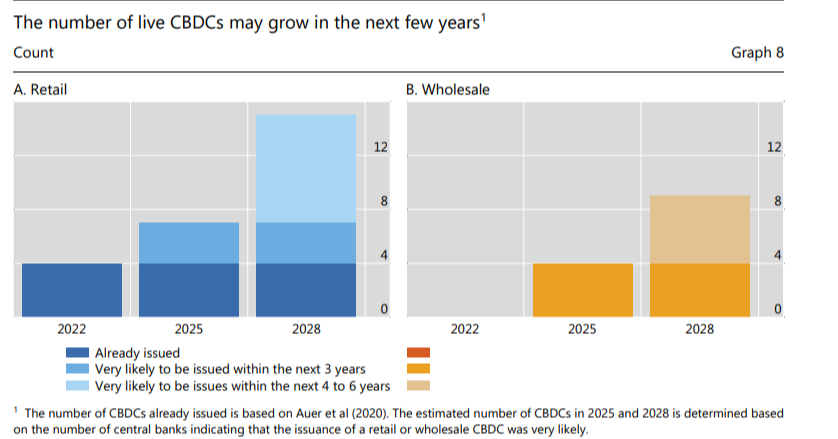
According to a survey by the Bank for International Settlements (BIS), 93% of central banks are researching central bank digital currencies (CBDCs). As per the report, by 2030, there could be as many as 15 retail and 9 wholesale CBDCs in circulation.

The survey of 86 central banks, published on July 10, took place from October to December 2022. It inquired whether central banks were working on retail, wholesale, or both forms of CBDC. They also accounted for the status of their work and their motivations.

A new era of finance with 24 CBDCs on the horizon

By the end of the decade, approximately two-dozen central banks in emergent and developed economies are anticipated to have digital currencies in circulation. In response to the accelerating decline of cash, central banks around the world have been researching and developing digital versions of their currencies for retail use to avoid leaving digital payments to the private sector.

24 CBDCs expected to be fully operational by 2030 – BIS Report24 CBDCs expected to be fully operational by 2030 – BIS Report

Emerging markets and developing economy nations are geoeconomically at the forefront of CBDC adoption. Their participation in piloting the retail (29%) and wholesale (16%) digital currencies is nearly double that of developed economies, which stands at 18% and 10%, respectively.

AE and EMDE central banks are contemplating the issuance of a retail digital currencies for convergent reasons. In both AEs and EMDEs, domestic payments efficiency and payments safety have become nearly equally essential over time. AE and EMDE (AE = advanced economies; EMDE = emerging market and developing economies.) central banks place roughly equal emphasis on financial stability and efficacy of cross-border payments.

24 CBDCs expected to be fully operational by 2030 – BIS Report24 CBDCs expected to be fully operational by 2030 – BIS Report

In 2022, the proportion of central banks that are projected to issue a retail digital currency within the next three years increased from 15% to 18%. At the same time, 68% of central banks are unwilling to issue a retail CBDC “anytime soon.”

There are now just four digital currencies in use: in the Bahamas, the Eastern Caribbean, Jamaica, and Nigeria. Nonetheless, based on central bankers’ responses, the survey estimates that 15 retail and 9 wholesale CBDCs will be operational by the end of this decade.

At the end of June, the Reserve Bank of India indicated that it was in talks with at least 18 central banks across the world about the prospect of making cross-border payments using its digital currency, the “digital rupee.” In July, the Innovation Centre of the Federal Reserve Bank of New York completed its proof-of-concept of a regulated liability network for a digital currency.

CBDCs set to take two different paths

As in prior years, central banks’ involvement in wholesale CBDC work is motivated by different incentives than their retail digital currency activities. In contrast to retail CBDCs, financial inclusion is the least major motivator of central banks’ efforts on wholesale digital currencies. Instead, the development of wholesale CBDC is motivated primarily by the aim to improve cross-border payments in both AEs and EMDEs. 

The Dunbar initiative Dunbar, the findings of which were published in 2022, is an example of a cross-border wholesale digital currency initiative. The Reserve Bank of Australia, the Central Bank of Malaysia, the Monetary Authority of Singapore, the South African Reserve Bank, and the BIS Innovation Hub collaborated on this project to investigate how a shared platform for multi-CBDCs could enable cheaper, faster, and safer cross-border payments.

24 CBDCs expected to be fully operational by 2030 – BIS Report24 CBDCs expected to be fully operational by 2030 – BIS Report

The likelihood of issuing a wholesale CBDC in the near future has also increased compared to last year: 16% of central banks believe it is likely that they will have a wholesale CBDC within the next three years, which is double the percentage of central banks from the previous year (8%).
24 CBDCs expected to be fully operational by 2030 – BIS Report24 CBDCs expected to be fully operational by 2030 – BIS Report

In addition, 58% are likely or capable of issuing a bond in the medium term, up from 54% last year.27 Additionally, the likelihood of issuing a wholesale CBDC is generally greater in EMDEs compared to AEs. 

According to the report, a legal framework granting central banks the authority to issue CBDCs is necessary for their issuance. The percentage of central banks with such legal authority increased marginally from 26% to 27% last year. 

In addition, approximately 8% of jurisdictions are currently amending or clarifying their laws to allow it. During the second quarter of 2023, the European Commission intends to propose a regulation to establish a digital euro (ECB, 2023). Still, one-fourth of central banks lack the necessary legal foundation, and roughly forty percent are uncertain. 

24 CBDCs expected to be fully operational by 2030 – BIS Report24 CBDCs expected to be fully operational by 2030 – BIS Report

As the development of digital currencies progresses, central banks’ skepticism about short-term CBDC issuance fades. There is a distinct divergence: compared to last year. Some central banks are more likely to issue a retail CBDC within the next three years, while others are less likely.

Disclaimer. The information provided is not trading advice. Cryptopolitan.com holds no liability for any investments made based on the information provided on this page. We strongly recommend independent research and/or consultation with a qualified professional before making any investment decision.

文章来源于互联网:24 CBDCs expected to be fully operational by 2030 – BIS Report

Disclaimers:

1. You are solely responsible for your investment decisions and this info is not liable for any losses you may incur.

2. The copyright of this article belongs to the writer, it represents the writer's opinions only, not represents the site's ones. Not financial advice.

Previous 2023年7月11日 09:43
Next 2023年7月11日 12:03

Related articles

  • U.S. court orders South African trading firm to pay $1.7 billion in crypto fraud case

    TL;DR Breakdown A U.S. District Court has ordered South African company Mirror Trading International (MTI) to pay $1.7 billion in restitution for operating a fraudulent bitcoin commodity pool. MTI had falsely promised investors significant trading gains through a non-existent proprietary software “bot,” leading to the misappropriation of a majority of the pooled bitcoin. Description A U.S. District Court has mandated that South African firm Mirror Trading International Proprietary Limited (MTI) pay $1.7 billion in restitution for operating a fraudulent bitcoin commodity pool.  The ruling, announced by the U.S. Commodity Futures Trading Commission (CFTC) on September 7,  brings closure to an enforcement case against MTI and its CEO, Cornelius Johannes … Read more A U.S. District Court has mandated that South African firm Mirror Trading International Proprietary Limited (MTI) pay $1.7 billion in restitution for operating a fraudulent bitcoin commodity pool.  The ruling, announced by the U.S. Commodity Futures Trading Commission (CFTC) on September 7,  brings closure to an enforcement case against MTI and its CEO, Cornelius Johannes Steynberg. MTI had lured investors with the promise of significant trading gains through…

    Article 2023年9月9日
  • BlackRock’s crypto journey: From skepticism to embracing digital assets

    TL;DR Breakdown BlackRock, the world’s largest asset manager, has filed for a spot Bitcoin ETF, showcasing a shift in its previous skepticism towards cryptocurrencies. The firm’s CEO, Larry Fink, had stated in 2018 that clients showed no interest in crypto, but since then, BlackRock has actively studied digital currencies and partnered with Coinbase to provide access to Bitcoin for institutional clients. If approved, the spot Bitcoin ETF could have significant implications for the cryptocurrency market, while BlackRock’s collaboration with Coinbase reflects a commitment to compliance amidst increasing regulatory oversight. Description In a surprising move, BlackRock, the world’s largest asset manager,filed an application for a spot Bitcoin exchange-traded fund (ETF) on Thursday. However, considering its previous skepticism, this development marks a significant shift in the firm’s stance towards cryptocurrencies. The move also highlights the changing attitudes of institutional players towards the crypto market since 2018. Contents … Read more In a surprising move, BlackRock, the world’s largest asset manager,filed an application for a spot Bitcoin exchange-traded fund (ETF) on Thursday. However, considering its previous skepticism, this development marks a significant shift…

    Article 2023年6月21日
  • I asked ChatGPT: What does the future hold for Vitalik Buterin?

    TL;DR Breakdown ChatGPT, OpenAI’s advanced language model, has speculated about the future of Vitalik Buterin, a renowned figure in the crypto industry. One prediction suggests the Ethereum founder may develop an eco-friendly teleportation device called “Etherportation,” which combines blockchain technology and quantum mechanics to revolutionize transportation. ChatGPT also proposes that he might delve into the world of music, collaborating with artists and tech experts to create a neural interface allowing individuals to compose music directly from their thoughts. The future of Vitalik Buterin, the ingenious crypto maven, is an enigma that many have pondered. Recently, a riveting dialogue with OpenAI’s advanced language model, ChatGPT, gave us a glimpse into the visionary paths that may lie ahead for Buterin, and what fascinating revelations they turned out to be. Buterin’s quantum leap ChatGPT, renowned for its insightful predictions and engaging narratives, started off by highlighting an unexpected venture that Buterin might embark on: developing an eco-friendly teleportation device. Yes, you read it right. The keyword here is ‘Etherportation,’ a term that resonates with Buterin’s iconic creation, Ethereum. The crux of this concept…

    Article 2023年6月3日
  • Atomic Wallet hackers move millions of stolen XRP tokens via major exchanges

    TL;DR Breakdown Fallout from the Atomic Wallet hack continues as stolen XRP tokens reappear and flow through major crypto exchanges. Expert team from Xrplorer tracks the stolen tokens, revealing hackers’ use of elaborate money laundering techniques to cover their tracks. Additional updates indicate hackers are cycling through exchanges to offload the stolen funds while authorities intensify efforts to bring them to justice. Description In the aftermath of the infamous Atomic Wallet hack, the repercussions persist as millions of stolen XRP tokens resurface, finding their way into major cryptocurrency exchanges. The incident, which occurred in early June and was allegedly carried out by the notorious North Korean group Lazarus, left a trail of despair among crypto enthusiasts. Recently, a … Read more In the aftermath of the infamous Atomic Wallet hack, the repercussions persist as millions of stolen XRP tokens resurface, finding their way into major cryptocurrency exchanges. The incident, which occurred in early June and was allegedly carried out by the notorious North Korean group Lazarus, left a trail of despair among crypto enthusiasts. Recently, a team of experts from…

    Article 2023年6月23日
  • Judge Rejects FTX’s Inclusion in Genesis Crypto Bankruptcy Talks

    TL;DR Breakdown FTX’s request to join confidential mediation in the Genesis bankruptcy case is denied by US Bankruptcy Judge Sean Lane. Genesis Global Holdco is given additional time to present a revised payout proposal, while also denying the exchange’s claim of $3.9 billion. In a significant development in the ongoing Genesis Global Holdco bankruptcy case, US Bankruptcy Judge Sean Lane has ruled against FTX Trading Ltd.’s request to join the confidential mediation sessions. FTX, which is also undergoing bankruptcy proceedings, had claimed that Genesis owed it $3.9 billion. Judge Lane’s decision has granted Genesis, its major creditors, and parent company Digital Currency Group (DCG) additional time to present a revised payout proposal, which would serve as the foundation for a Chapter 11 bankruptcy plan. This article provides an in-depth analysis of the latest court ruling and its implications on the Genesis bankruptcy case. Contents hide 1 Judge Rejects FTX’s Participation in Confidential Mediation 2 Additional Time Granted for Revised Payout Proposal 3 Genesis Denies FTX’s Claim and Requests Estimation Process 4 Conclusion Judge Rejects FTX’s Participation in Confidential Mediation US…

    Article 2023年6月11日
TOP